- Blog
- Car Taxes in Finland - Guide for Car Dealers
Car Taxes in Finland - Guide for Car Dealers
Understand the main car taxes in Finland and see what you’ll pay when importing used cars from the EU or outside the EU.
Buying and reselling used cars in Finland means that you have to be familiar with the car taxes you and your buyers are paying.
These car taxes decide how attractive a car is for your customers, how you price your stock, and how much profit you keep on each deal.
To help you stay informed, we’ll look at the key taxes you’ll meet. You’ll then be able to estimate total costs and explain them to buyers, keeping both sides clear on what they’re paying for.
List of all motor taxes in Finland
We’re starting with a brief overview of the main car-related taxes, and we’ll see more details about each one later.
|
Tax |
What it is |
When it’s paid |
Applies to |
|
Car tax (Autovero) |
One-time tax on vehicles entering use in Finland |
Once, when the vehicle is first registered or taken into taxable use |
All newly registered vehicles, including imported used cars |
|
Vehicle tax (Ajoneuvovero) |
Annual tax for keeping a vehicle on the road |
Yearly |
Vehicle owners |
|
VAT |
General sales tax on vehicles |
Once, on car purchase or import |
Most vehicle sales |
|
Customs duty |
Import duty on non-EU vehicles |
Once, on import |
Importers bringing cars from outside of the EU |
|
Registration and administrative fees |
Fixed charges for registration, plates and required inspections |
When registering a vehicle |
Vehicle owners |
Finnish car taxes explained
Let’s proceed by explaining these car taxes.
► Car tax (Autovero)
Autovero is a one-time car tax you pay when a vehicle is registered for the first time in Finland, including when you bring a used car in from abroad.
The amount of car tax is based on the car’s taxable value (so, not necessarily the invoice value!) on the Finnish market and its CO₂ emissions.
You can use an official calculator by Vero.fi to estimate the tax for a used vehicle once you know its Finnish market value and emissions.
Car tax is handled by the Finnish Tax Administration.
► Vehicle tax (Ajoneuvovero)
Vehicle tax, called Ajoneuvovero, is the yearly tax you pay to keep a vehicle registered and in use in Finland.
This tax is paid in advance for a period of 12 months, and it’s applicable to passenger cars and all other vehicle types that are registered and in operation in Finland.
The tax amount is mainly based on CO₂ emissions (or weight for some older vehicles), and it also depends on fuel type.
Ajoneuvovero is collected by Traficom, not the Finnish Tax Administration.
► Value Added Tax (VAT) - 25.5%
VAT is the general sales tax that applies to most vehicle sales and to vehicle imports from outside the EU. The general VAT rate in Finland is 25.5%.
Now, if you’re importing used cars to Finland, there are two options for handling VAT, and they depend on how the seller invoices the car:
- Under the standard VAT scheme, VAT is charged on the full selling price and you can usually deduct input VAT as a dealer.
- Under the margin scheme, VAT is only calculated on your profit margin, not on the full sale price, and you can’t deduct it.
Essentially, the difference between these schemes is whether you can reclaim your VAT.
You can reclaim it with cars invoiced under the standard VAT scheme, and you usually can’t reclaim it with cars sold under the margin scheme, because VAT isn’t shown separately on the invoice.
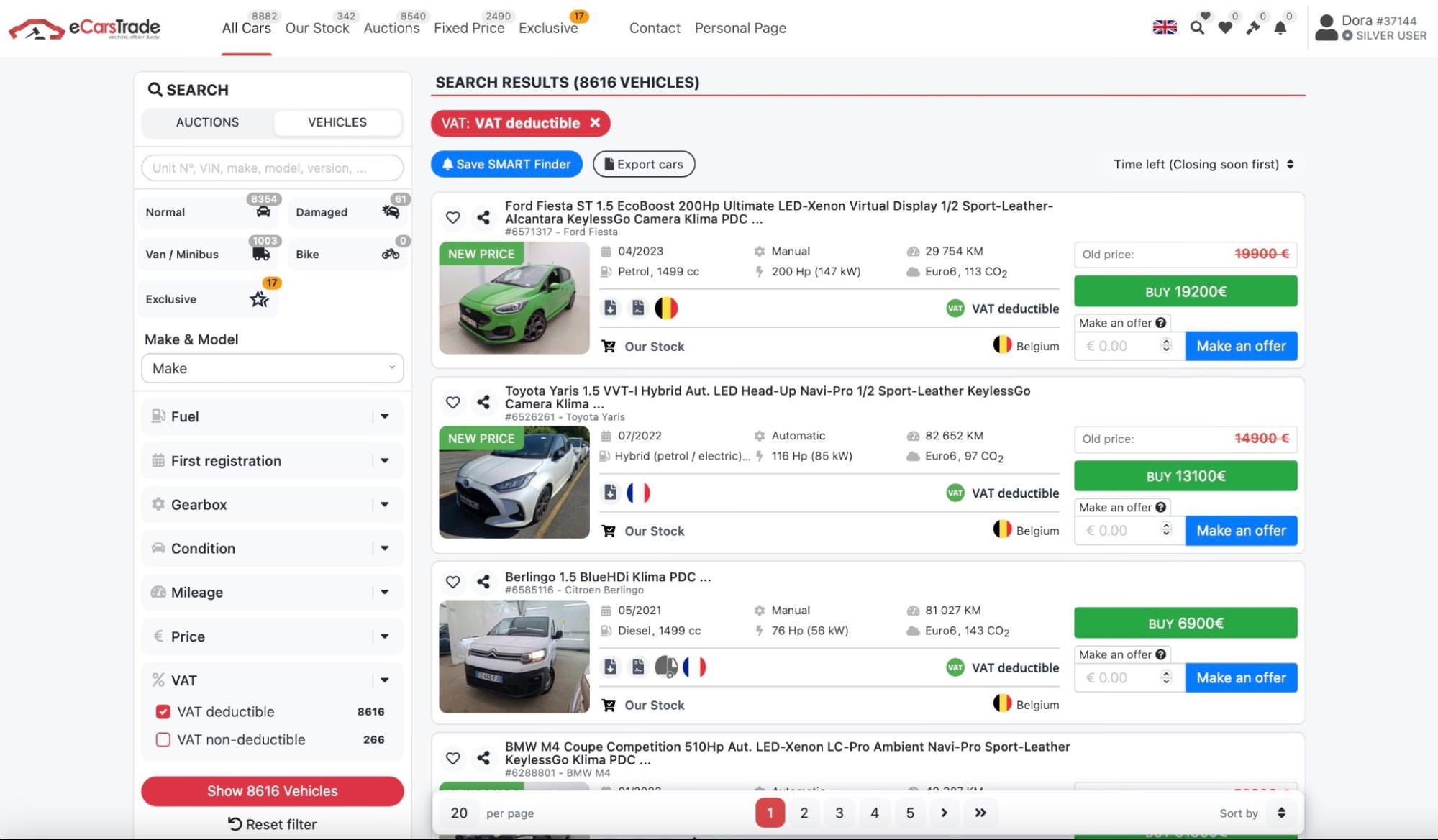
Since the difference is important and affects how you’ll price the cars you’re selling, the VAT scheme is clearly marked on every eCarsTrade listing.
You can also filter cars by VAT scheme to only see the VAT invoicing type that fits you the most.
► Customs duty
If you’re importing a car from outside of the EU, you’ll also pay customs duty. The duty amounts to 10% of the car value, including the purchase price, transport and insurance costs.
Note that once customs duty is added, Finnish VAT is then calculated on top of that total, which means both charges end up in the final cost of importing a non-EU car.
And in case you’re importing a car from another EU country, you won’t be paying customs duty.
► Registration fees
Besides the taxes we’ve just seen, there are several other fees you or your buyers will have to cover.
These are not precisely taxes, but they still add to the final cost of owning a car, so it’s worth keeping them in mind when you calculate your costs.
These fees include:
- Registration fees (about €125 for first registration of an imported car)
- Registration inspection (usually between €50 and €100, depending on the inspection station)
- Registration plates (€5.50 per plate)
Depending on the inspection station and the exact service used, you're looking at around 200 EUR total in administrative or registration fees.
Tax rates in Finland - by vehicle type
Let’s see how tax rates differ between the main vehicle types in Finland.
Passenger cars - petrol vs diesel
The main difference between petrol and diesel cars is the driving power component of the annual vehicle tax (ajoneuvovero):
- Petrol cars pay only the basic part based on CO₂.
- Diesel cars pay the basic CO₂-based part plus an extra diesel charge, which makes their yearly tax higher.
Electric Vehicles
Car tax (autovero) for fully electric cars is 0%, so there is no one-time registration tax when you bring an EV into Finland.
Vehicle tax (ajoneuvovero) has no CO₂-based part (because EVs have zero emissions), but EVs do pay a small amount here, because any vehicle that is not petrol-powered has to pay it.
That’s right: depending on the model’s CO₂ emissions, some efficient petrol cars can have a slightly lower annual tax than EVs.
Still, EVs keep their overall costs low thanks to zero autovero and lower annual tax than diesel cars.
Plug-in-Hybrids
Plug-in hybrids in Finland sit between petrol/diesel cars and full EVs in terms of tax.
Based on CO₂ and the car’s taxable value. PHEVs usually pay less car tax (autovero) than pure petrol or diesel cars because they have lower CO₂ ratings.
When it comes to vehicle tax (ajoneuvovero), hybrids pay more than a similar pure petrol car because of the driving-power component, but still less than a diesel, especially petrol-based PHEVs.
Note that hybrids will see some changes in the vehicle tax starting in 2026. From 1 January 2026, Traficom lists the driving power tax rates for passenger cars as:
- Electricity and petrol (plug-in hybrid): 0.95 cents per day per 100 kg
- Electricity and diesel (plug-in hybrid): 3.6 cents per day per 100 kg
This means that petrol PHEVs will see a small increase in their annual tax compared with the previous rate.
Commercial vehicles
Commercial vehicles (mostly vans) follow the same tax rules as passenger cars.
Car tax (autovero) is based on CO₂, and the yearly vehicle tax (ajoneuvovero) depends on CO₂ and fuel type.
Petrol vans pay only the basic part, while diesel vans also get the extra diesel charge, just like diesel passenger cars.
Motorcycles
Motorcycles follow a simple tax scheme. When you first register a bike in Finland, you pay car tax (autovero) once.
After that, it’s easy, as motorcycles don’t pay ajoneuvovero, so there’s no yearly vehicle tax like with cars or vans.
Tax calculators and official resources
When you’re evaluating a specific car or van, it’s much easier to plug the data into official tools than to read tax tables. Here are the two official calculators you can use to estimate:
What will change in 2026?
2026 won’t come with changes in how motor taxes work, but the amounts you’ll pay will change a bit.
According to Traficom, two main things will happen from 1 January 2026:
- Electric cars and other low-emission cars will get an increase in the basic part of their annual vehicle tax. For fully electric cars, that increase is €52.91 per year.
- The driving-power part of the annual vehicle tax (ajoneuvovero) will change for cars that are not petrol-only:
- Electricity (EVs): 1.5 → 1.9 cents/day/100 kg
- Petrol plug-in hybrids: 0.5 → 0.95 cents/day/100 kg
- Diesel plug-in hybrids: 4.9 → 3.6 cents/day/100 kg
So while most electrified cars will see a small rise in their yearly tax, diesel plug-in hybrids are the exception, as their rate will decrease a little.

Tax scenarios for Finnish dealers
Let’s say you wanted to import used cars into Finland. Here are the common scenarios you can expect in terms of car taxes.
► Importing a used car from Germany
In this scenario, you’ll first pay the one-time car tax (autovero) when you register the vehicle in Finland.
And because the car comes from another EU member state, you won’t have to pay customs duty at the border.
As for VAT, What you pay depends on how the car is invoiced.
If the seller issues a standard VAT invoice, you usually buy the car at the net price and then declare Finnish VAT in your own VAT return. If the seller uses the margin scheme, VAT isn’t shown separately on the invoice and you can’t reclaim it in Finland.
Finally, the buyer registering the car in their name will pay the usual Finnish registration fees, and the annual vehicle tax (ajoneuvovero) as well.
► Importing an Electric Vehicle from EU
Importing an EV from another EU country works almost the same as any other EU import, with one big difference: you won’t pay car tax (autovero) because the rate for fully electric cars is 0%.
Here’s what you’ll deal with:
- VAT (standard or margin scheme, depending on the seller’s invoice)
- Registration fees (inspection, registration process and number plates)
- Annual vehicle tax (ajoneuvovero) once the car is registered
That’s the full list. With no autovero and no customs duty on EU cars, importing an EV is one of the simplest tax scenarios for Finnish dealers.
► Importing from a non-EU country
Bringing a used car from a non-EU country is the most complex scenario because it covers all major charges. Still, it’s doable, and here’s what you’ll have to prepare for:
- Customs duty, at 10% of the car’s customs value (purchase price + transport + insurance)
- VAT, charged on top of the customs value plus the duty
- Car tax (autovero) when the car is first registered or taken into use in Finland
- Registration fees
- Annual vehicle tax (ajoneuvovero) once the car is registered.
So unlike EU imports, the non-EU import includes duty, VAT and autovero together, which makes it the most expensive option for Finnish dealers.
FAQ
► Do I always have to pay car tax (autovero) when importing a used car?
Most of the time, yes. Every imported car pays autovero except fully electric vehicles, which have a 0% rate.
► When can I reclaim VAT on imported cars?
You can reclaim VAT only if the car is invoiced under the standard VAT scheme. Cars sold under the margin scheme don’t show VAT separately, so you can’t reclaim it.
► Do electric vehicles pay any taxes when imported?
EVs don’t pay autovero, but they still have VAT, registration fees, and a small annual vehicle tax (ajoneuvovero) once registered.
► What taxes apply to non-EU imports?
Non-EU cars have to pay customs duty, VAT, autovero, registration fees, and annual vehicle tax after registration. This makes them the most expensive import scenario.
► Who do I pay car tax and vehicle tax to?
You pay car tax (autovero) to the Finnish Tax Administration, and the annual vehicle tax (ajoneuvovero) to Traficom.
O nosso vasto inventário inclui várias marcas e modelos para satisfazer todas as suas necessidades, provenientes diretamente de reputadas empresas europeias de leasing, empresas de aluguer de curta duração e concessionários: