- Blog
- How to Import a Car to Slovenia
How to Import a Car to Slovenia
Learn how to import a car to Slovenia as a business, including the key documents, VAT and DMV taxes, and see the step-by-step process from purchase to registration.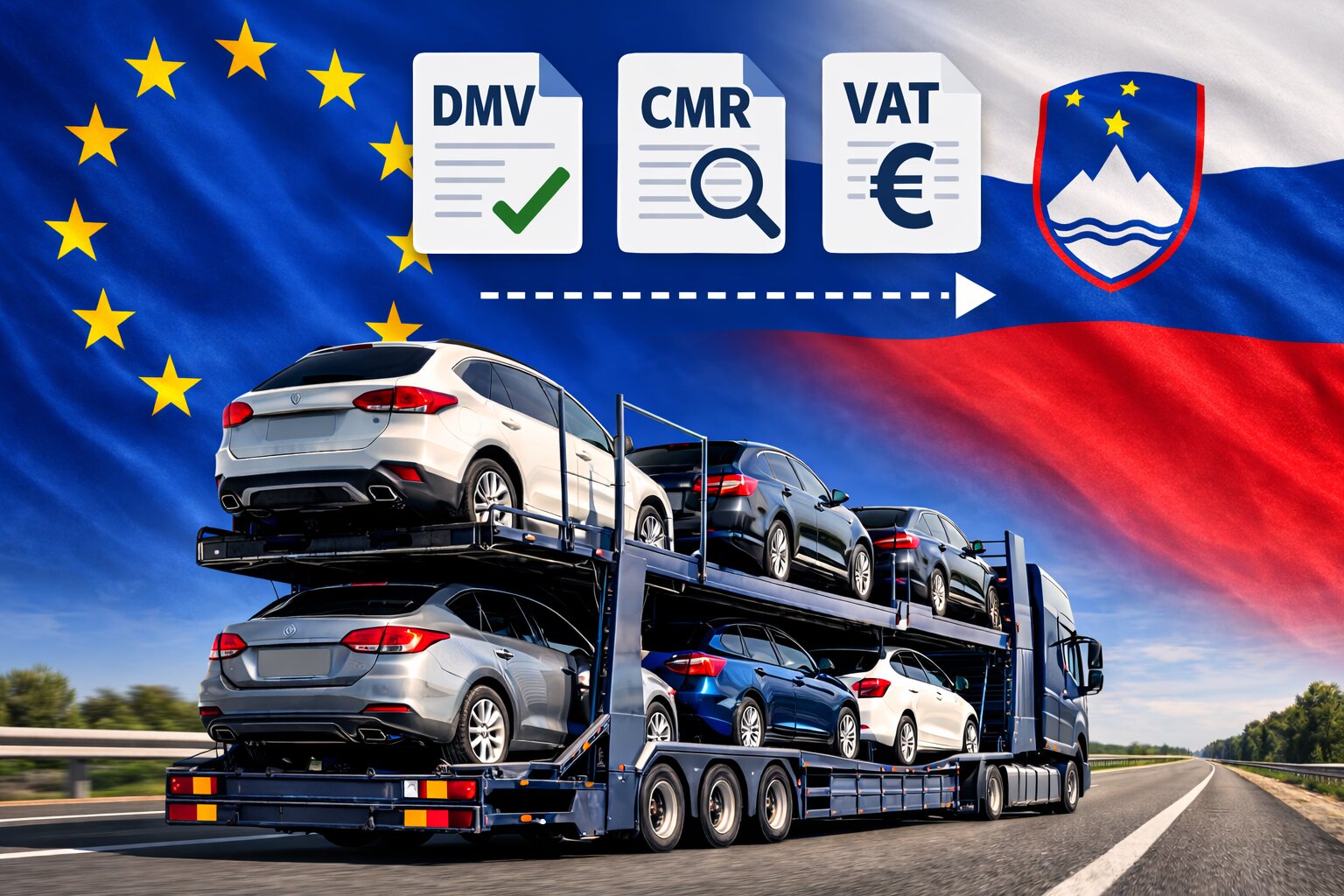
If you’re looking for a way to expand your dealership’s offer, importing cars from the EU to Slovenia can be a practical option.
Sourcing from various European markets lets you compare prices more easily and pick vehicles that match your buyers’ needs.
However, to get the most value from EU imports, you need to know what paperwork you’ll need and which taxes apply in Slovenia.
We’ll show you how the import process works in practice, from preparing the documents to checking the total charges before you buy.
Documentation for importing a vehicle to Slovenia as a business
There are several key documents you’ll need during import. Here’s a list of all the documentation you’ll have to prepare.
► Vehicle purchase invoice
When you buy the vehicle, you’ll receive a vehicle purchase invoice, which is the first document you’ll need. It proves that your business has bought the car.
The purchase invoice contains seller and buyer details, VIN, the purchase price, and the VAT scheme used.
If you’ve bought a car via eCarsTrade, you can find the invoice on your Personal page.

► Original registration documents
You’ll also need the car’s registration papers from the country of origin. The original registration papers are used to confirm technical data and registration history.
When you’re sourcing cars from eCarsTrade, you have one thing less to worry about, as all cars here are sold with original registration documents.
► Certificate of Conformity
Like most EU countries, Slovenia requires a Certificate of Conformity (COC) during the import and registration process.
This document is issued by the manufacturer and confirms that the vehicle complies with EU requirements.
You should note that used cars are commonly sold without their original COC documents.
That’s an easy problem to solve, as you can purchase a replacement COC from providers such as EUROCOC or COC Europe.
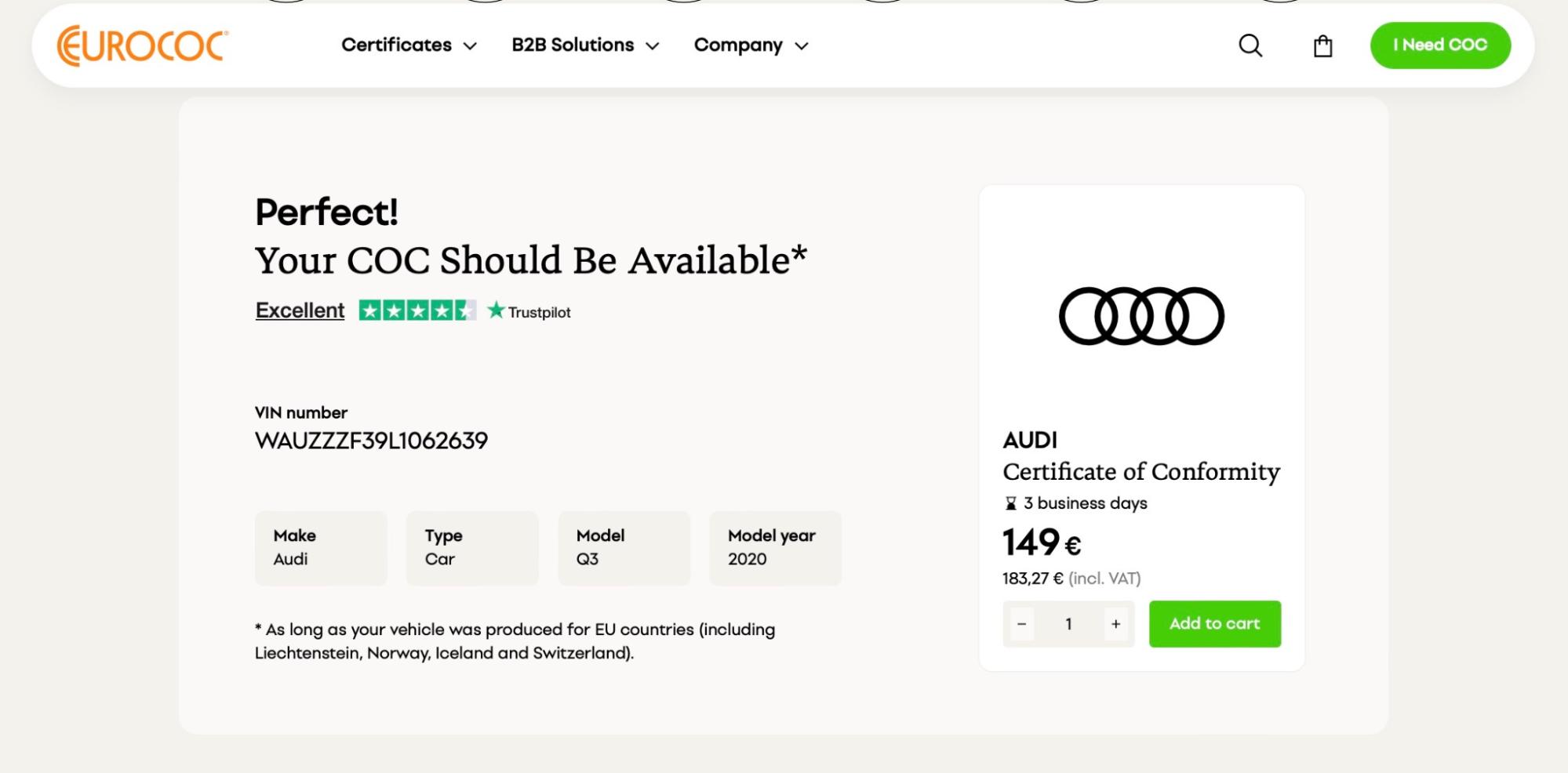 Source: EUROCOC
► Proof of identity and business registration
You should also prepare proof of identity. If you’re importing as a business in Slovenia, remember to prepare proof of your company’s registration.
You’ll also need the ID of the company representative handling the import.
Taxes when importing a car to Slovenia
How do you make sure your imports are actually profitable for your dealership?
By calculating all import-related taxes before you buy cars. Let’s see what these are.
VAT (Value added tax)
VAT is one of the biggest factors that influences the cost of your imports. Generally, VAT on vehicles depends on whether you’re buying new or used cars.
When you buy used cars from other EU members, the amount of VAT will depend on the VAT scheme used.
There are two VAT mechanisms: the standard VAT system and the margin scheme.
In the standard VAT scheme, the car is sold with deductible VAT, which means the seller lists the price without VAT and the VAT is handled separately.
On eCarsTrade, these vehicles are marked “VAT deductible”.
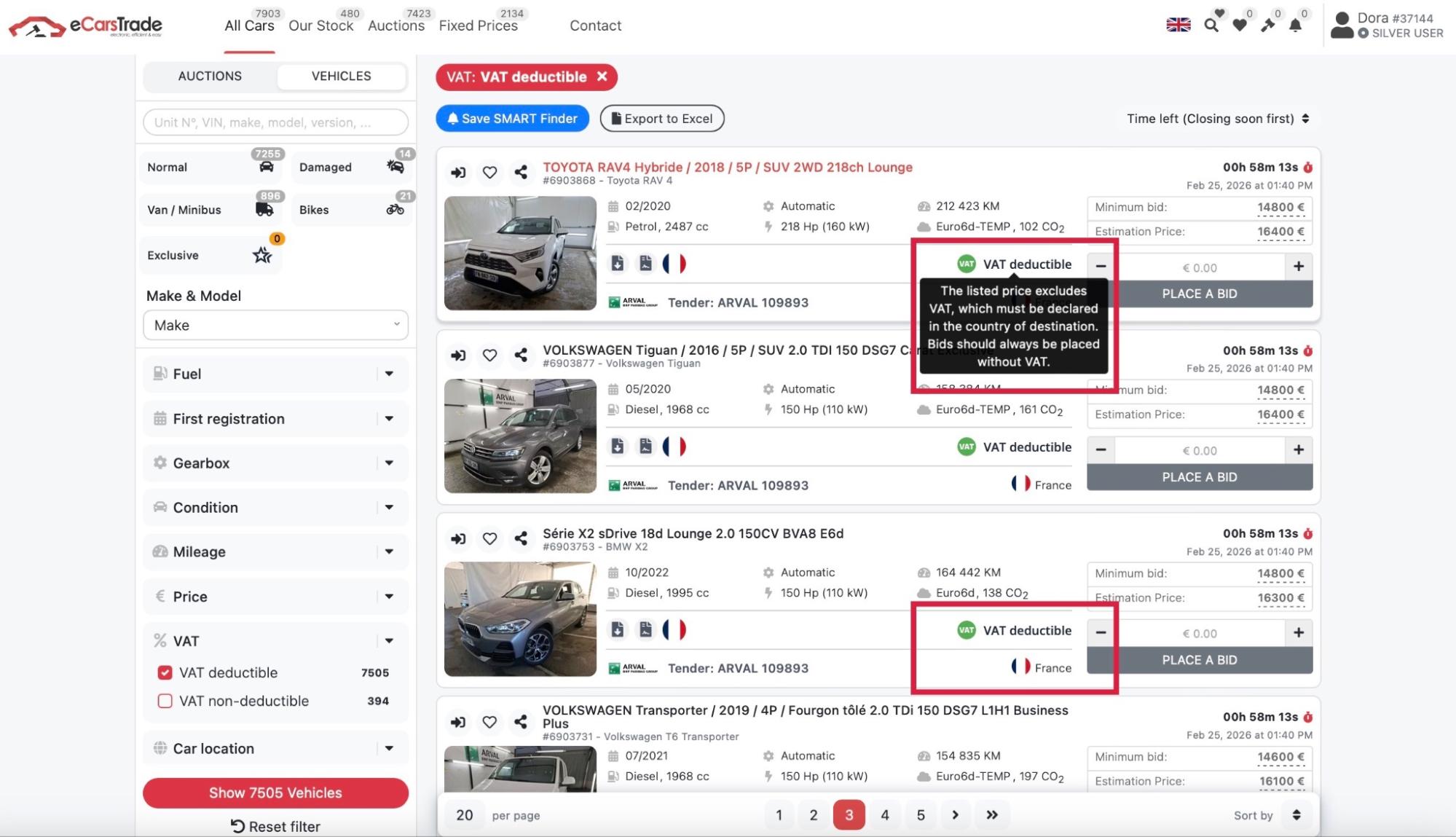
If you buy such a car as a Slovenian business from another EU member state under the standard VAT scheme, you usually need to report VAT in Slovenia under intra-EU acquisition rules.
For means of transport, the VAT rate is 22%.
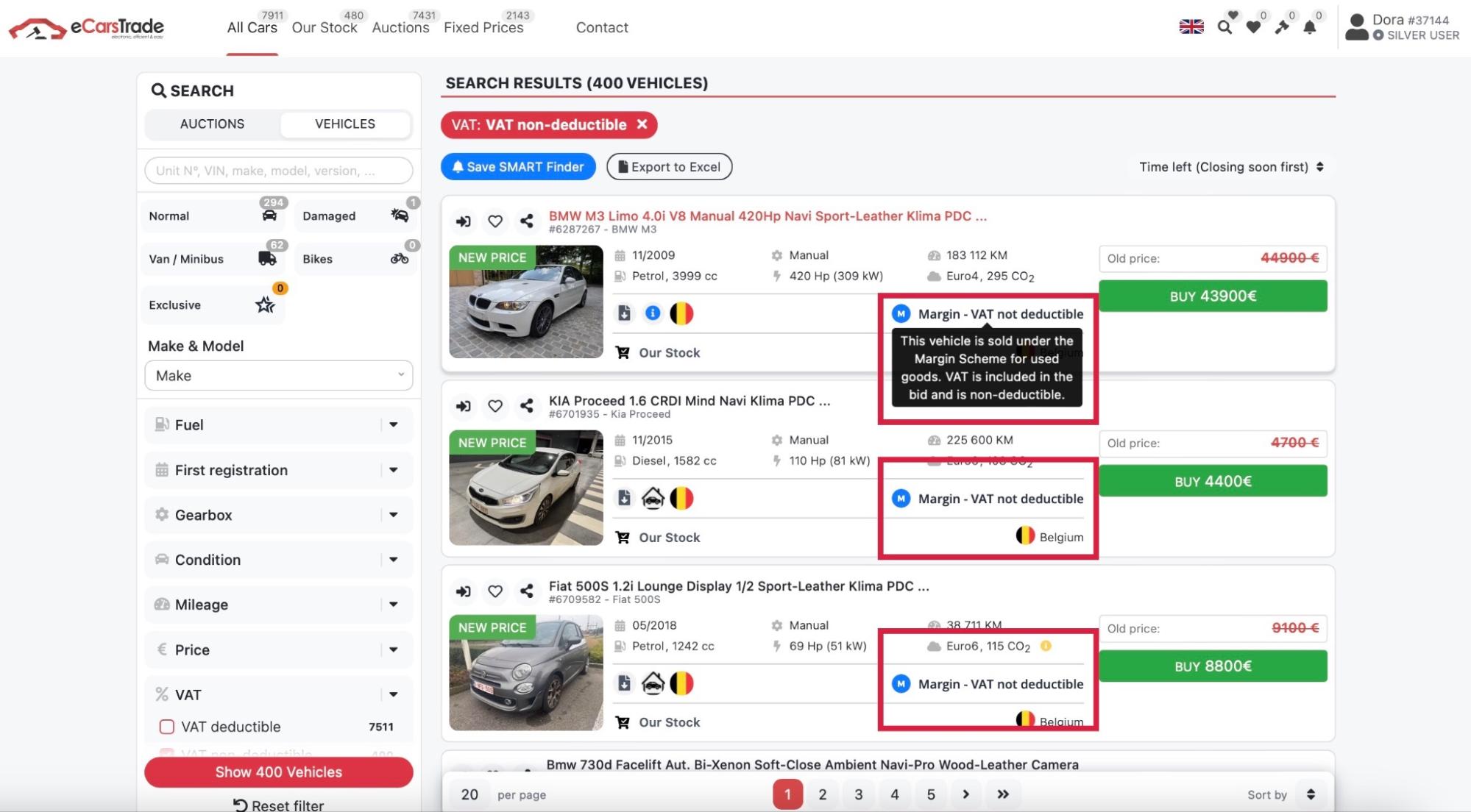
If the seller uses the margin scheme for used goods, you don’t pay VAT in Slovenia on that EU purchase.
On eCarsTrade, such cars are marked as “Margin - VAT not deductible.”
Motor vehicle tax/Davek na motorna vozila (MVT/DMV)
You’ll also need to pay motor vehicle tax (MVT) when the car is registered in Slovenia for the first time. The Slovenian term is DMV, short for davek na motorna vozila.
The amount of the DMV you’ll pay depends on the car’s fuel type, CO₂ emissions, engine power, and EURO emissions standard.
EVs don’t have to pay DMV, so that can significantly lower your total import cost.
To pay the DMV, you’ll first have to homologate the car, then submit the DMV-N tax form through eDavki, and pay the assessed tax before first registration in Slovenia.
If you’d like to get an estimate of DMV in advance, you can visit the official FURS DMV page, where you can find an Excel file with the official DMV tax tables and calculation logic.
You can use it to estimate the DMV amount before buying.
For instance, based on the calculation document, the estimated DMV for the Mercedes B 180 diesel (2020) is about €97.
Of course, you should always check the final amount using the exact data for the car you’re interested in.
Customs duty
If you buy a car from another EU country, you do not pay customs duty in Slovenia.
If you import a car from outside the EU, customs duty will apply. The rate is not the same for every vehicle, so you should check the EU TARIC database to confirm the customs duty.
Step-by-step process - from purchasing a car to importing it to Slovenia
Now, let’s see precisely what steps you’ll need to take from buying a used car to registering it in Slovenia.
1. Research and buy the car
The process starts with selecting the right car for your market and buying it.
To expand your choice and compare offers across Europe more easily, you can browse online auctions on eCarsTrade.
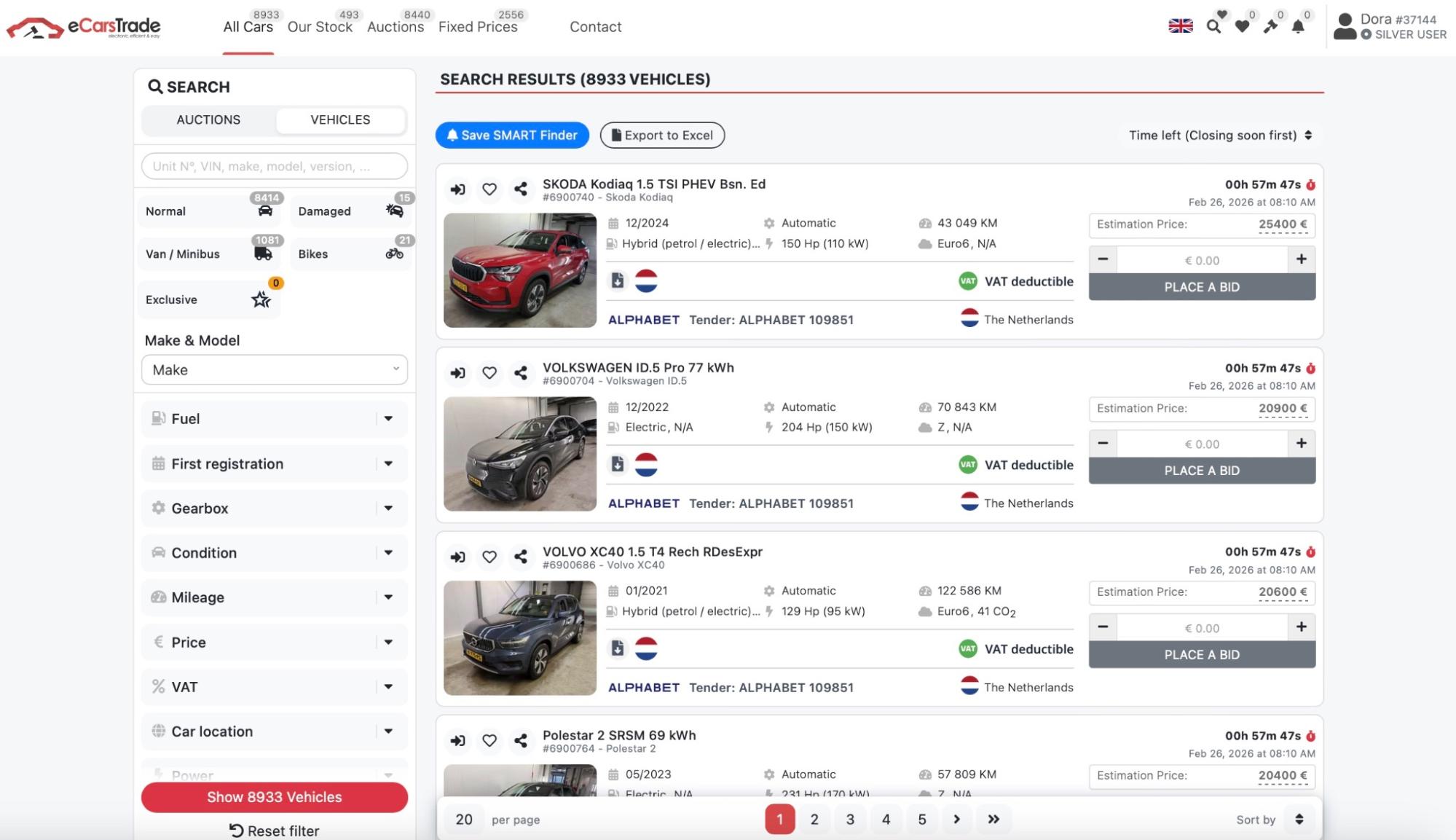
eCarsTrade lets you browse vehicles by make, mileage, fuel type, and price range before bidding.
For each listing, you can also review detailed information about the car’s condition, including notes on damage or wear, so you’ll know exactly what you're buying.
After you’ve won an auction, you can make the payment directly within eCarsTrade.
2. Arrange transport
You’ve bought the car, and now it’s time to bring it to Slovenia. The most practical way to do this is via eCarsTrade Delivery Service.
The Delivery Service takes care of transport and the related documents, and the only thing you need to do is to have a lot accessible by truck.
You could also drive the car yourself, but that usually takes more time and planning.
In that case, you’ll usually need transit plates and the insurance from the country of origin, so you can legally drive the car across borders.
Also, plan for motorway tolls: you should buy a vignette before you enter Slovenia, and if you’re driving through Austria, you’ll need an Austrian vignette as well.
3. Prepare the documents
Next, gather the documents you’ll need during the import process:
- Vehicle purchase invoice
- Original registration papers
- COC
4. Homologate the car
Once the car is in Slovenia, you’ll take it to a homologation center. Some of the options you have are AMZS centers, Avto Krka, and LPP Technical Inspections.
There, they confirm the car’s technical data, like CO₂ emissions and the EURO standard, usually based on the COC and original registration papers.
Once you have the confirmed emissions data, you have the base for the next step: submitting the DMV-N tax form.
5. Submit the DMV-N form
After homologation, submit the DMV-N form electronically through eDavki so FURS can assess the DMV amount.
6. Pay DMV and VAT
After you submit DMV-N, FURS issues a DMV assessment decision, which you’ll usually receive in eDavki. Use the payment details from that decision and pay DMV by bank transfer.
When you’ve paid the DMV, it’s time to pay the VAT, if it applies to you.
If you bought the car under the standard VAT scheme, you handle VAT through your regular VAT reporting.
You report the intra-EU purchase in your Slovenian VAT return (DDV-O) in eDavki, and VAT is settled as part of your normal VAT payment for that tax period.
If the car was sold under the margin scheme, you skip the VAT step.
7. Register the car
Once the tax step is completed, you can register the vehicle with the registration authority.
For example, you could go to an AMZS registration center or another authorized provider.
There, you’ll submit the required car documents and proof that DMV (and VAT, if applicable) has been settled, and you’ll receive Slovenian registration and licence plates.
Get to know the Slovenian used car market
Slovenia has been recording an increasing number of used cars on the streets. For instance, the number of used passenger cars from abroad rose by 3% in 2024 compared to 2023.
Another thing that could impact your choice of cars to import is that the Slovenian EV market has increased. Now, EVs have a market share of more than 10%.
When it comes to the most popular models, these were sold the most in 2025, according to BestSellingCarsBlog:
- Renault Clio
- Skoda Octavia
- Renault Captur
- Skoda Kamiq
- Skoda Kodiaq
- Volkswagen T-Roc
- Volkswagen Tiguan
- Hyundai Tucson
As you can see, it’s mostly well-known, mainstream cars. But in case your dealership is focused on business buyers or fleets, you may also want to look at practical company cars or LCVs.
Either way, you should check your local demand before you buy.
Importing a car to Slovenia - FAQ
► Do I pay VAT when importing a used car from another EU country?
It depends on the VAT scheme on the invoice. Under the standard VAT scheme, you usually report VAT in Slovenia. Under the margin scheme, you don’t pay VAT.
► Do I pay customs duty when importing a car from an EU country?
No, if you buy the car from another EU country, you don’t pay customs duty in Slovenia.
► What is DMV, and how much is it?
DMV is the Slovenian motor vehicle tax (MVT). There is no flat rate. The amount depends on the car’s fuel type, CO₂ emissions, engine power, and EURO emissions standard.
► Do EVs pay DMV in Slovenia?
No. Fully electric vehicles do not pay DMV, which can lower your total import cost.
► Where do I homologate a car in Slovenia?
You can use homologation centers such as AMZS centers, Avto Krka, or LPP Technical Inspections.
A importação de veículos da Europa pode ser complexa, mas a eCarsTrade está aqui para simplificar o processo. Saiba como: